


How Much Does Pressure Cleaning Cost? Per Job, Per m², Per Hour Guide
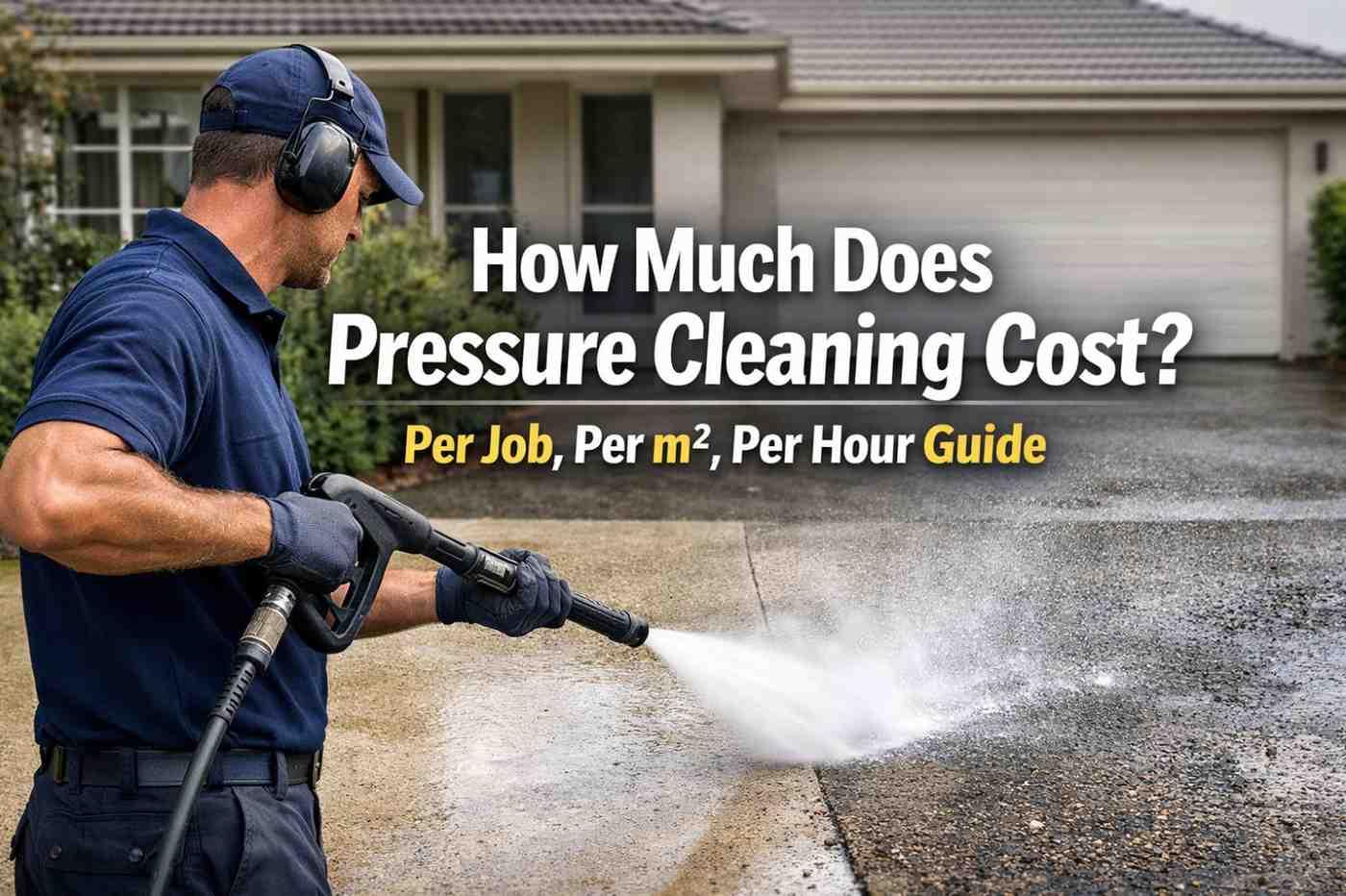
Pressure cleaning typically costs between $150 and $800 per job for residential properties, and from $0.08 to $0.50 per square foot depending on the surface, method, and condition. Most homeowners pay around $250 to $450 for a standard residential clean. Commercial jobs can reach $1,000 or more, depending on the scope.
Three pricing models are in common use: flat-rate per job, per-square-foot (or per-square-metre), and hourly rates. The model a provider uses depends on the job type, their region, and the complexity of the work involved.
|
QUICK REFERENCE: AVERAGE PRESSURE CLEANING COST RANGES Driveway: $100–$300 | Patio or deck: $100–$400 | House exterior: $250–$800 | Roof: $300–$700 | Fence: $120–$350 | Hourly rate: $50–$160 | Per sq ft: $0.08–$0.77 |
The reason cost ranges are so wide is not vague pricing; it reflects real variable inputs: the size and type of surface, how dirty it is, the method required (pressure, soft wash, or power wash), access difficulty, and local labour rates. This guide explains every one of those variables so you can understand any quote you receive.
The Three Pricing Models Explained
Pressure cleaning companies use three main pricing structures. Each model suits different job types, and many providers use a hybrid approach.
1. Flat-Rate Per-Job Pricing
Flat-rate pricing means you pay a fixed fee for a defined job, for example, one driveway, one roof, or one patio. This is most common for standard residential jobs where the scope is predictable. It gives clients certainty before work begins. The risk for the provider is that an unusually dirty or large area may take longer than expected, which is why experienced cleaners assess the job first.
2. Per-Square-Foot (or Per-Square-Metre) Pricing
Per-area pricing is the most transparent model for larger surfaces. Rates typically range from $0.08 to $0.77 per square foot, depending on what is being cleaned. Commercial cleaning companies often default to per-square-foot pricing because it scales accurately with project size. For very large surfaces, such as shopping centre car parks, warehouse floors, or multi-level facades, a per-square-metre rate is both clearer and fairer for the client.
3. Hourly Rate Pricing
Hourly rates range from $50 to $160 per hour, depending on the provider, equipment, and location. Most residential jobs take between two and four hours. Hourly pricing suits irregular jobs where the scope is hard to define upfront, for example, heavily contaminated industrial surfaces, or properties with complex access requirements. If you are quoted by the hour, ask for a realistic time estimate before work begins.
|
Pricing Model |
Typical Rate |
Best Suited For |
|
Flat rate per job |
$100–$800+ |
Standard residential driveways, patios, and roofs |
|
Per square foot |
$0.08–$0.77/sq ft |
Large surfaces, commercial jobs, house exteriors |
|
Hourly rate |
$50–$160/hour |
Complex jobs, industrial surfaces, irregular access |
|
Package pricing |
Bundled discount |
Multiple surfaces cleaned in a single visit |
Average Pressure Cleaning Cost by Surface Type
Surface type is one of the strongest predictors of cleaning cost. Different materials require different pressure settings, nozzle types, cleaning solutions, and dwell times, all of which affect the final quote.
Driveways and Concrete
A concrete or asphalt driveway typically costs $100 to $300 to pressure clean, depending on size and contamination. Per-square-foot rates range from $0.20 to $0.40. Oil stains, tyre marks, or deep-set mildew can push the cost higher because they require pre-treatment and more passes. New concrete with only surface dirt sits at the lower end. Gravel driveways are not suitable for high-pressure cleaning; a specialist method or manual approach is needed.
Patios and Decks
Patios and decks cost $100 to $400 on average. The material matters significantly here. Concrete and stone patios can withstand standard high-pressure cleaning. Wooden decks and composite materials require careful pressure management; too high a PSI damages the fibres and lifts paint or sealant. Soft washing or low-pressure methods are often the safest approach for timber. If the deck also needs re-staining or sealing after cleaning, budget an additional $100 to $300 for that service.
House Exterior and Siding
Cleaning the exterior of a house typically costs $250 to $800 for a standard single-storey home, rising to $500 to $1,500 or more for larger two-storey properties. Per-square-foot rates for house exteriors range from $0.10 to $0.50, depending on siding material. Vinyl siding is the least expensive to clean ($0.15–$0.30 per sq ft), while brick, stucco, and fibre cement require more care and sit at the higher end ($0.30–$0.50 per sq ft). Second-storey or roof-height sections require extension lances, elevated access, or scaffolding, all of which add to labour time and cost.
Roof Cleaning
Roof cleaning costs between $300 and $700 for most residential properties, with per-square-foot rates of $0.50 to $1.00. This is consistently higher than other surfaces for two reasons. First, access difficulty working at height requires safety harnesses, specialised ladders, or elevated equipment. Second, surface-sensitivity asphalt shingles, terracotta tiles, and metal roofing all require soft washing rather than high-pressure jets. Using the wrong PSI on a roof can dislodge granules from shingles, void roofing warranties, and cause long-term water damage. Professional roof cleaners apply a biodegradable biocide solution at low pressure, then rinse gently once the organic growth is dead.
Fences
Fence cleaning costs $120 to $350, depending on material and linear length. Timber, Colorbond, and brick fences all need different treatments. Wooden fences with old paint, heavy algae, or water staining can push costs up to $400 or more if stripping or prep work is involved. Very long boundary fences are often quoted per linear foot or metre.
Gutters and Fascia
Exterior gutter cleaning (removing streaks, oxidation, and biological staining from the outside face) costs roughly $0.50 to $1.50 per linear foot. For a standard single-storey home, this typically adds $50 to $200 to the job. Internal gutter clearing (removing leaf debris and blockages from inside the gutter) is a separate service priced differently.
Commercial Surfaces and Car Parks
Commercial pressure cleaning is quoted differently from residential work. Large concrete areas, loading docks, car parks, and building facades are typically priced at $0.30 to $0.75 per square foot. Minimum call-out fees for commercial sites can be $200 to $500, depending on equipment requirements. Jobs needing hot water (power washing) for grease removal, or chemical treatment for heavy contamination, sit at the higher end.
|
Surface Type |
Typical Cost Range |
Notes |
|
Driveway (concrete/asphalt) |
$100–$300 |
Oil stains add cost; new concrete at the lower end |
|
Patio or deck |
$100–$400 |
Timber requires soft wash; sealing costs extra |
|
House exterior (single storey) |
$250–$500 |
Material type affects the rate significantly |
|
House exterior (two-storey) |
$500–$1,500+ |
Height access adds labour and time |
|
Roof cleaning |
$300–$700 |
Almost always soft wash; safety equipment required |
|
Fence |
$120–$350 |
Long fences quoted per linear metre |
|
Gutters (external face) |
$50–$200 add-on |
Separate from internal gutter clearing |
|
Commercial / car park |
$0.30–$0.75/sq ft |
Minimum call-out fees often apply |
|
Graffiti removal |
$200–$800+ |
Depends on surface and paint type |
7 Key Factors That Change Your Pressure Cleaning Quote
Two properties can look identical from the street and still receive very different quotes. These are the variables that actually drive the difference.
1. Surface Area
The larger the area being cleaned, the higher the total cost, but not always proportionally. Larger jobs often attract a lower per-unit rate because setup time, equipment mobilisation, and travel are spread across a larger area. A quote for 50 square metres of driveway will cost more per square metre than a quote for 200 square metres of the same surface.
2. Surface Condition and Contamination Level
A lightly soiled patio cleaned annually costs far less than one that has been neglected for five years. Heavy organic growth (moss, lichen, algae), deep oil staining, rust, or mineral deposits all require pre-treatment chemicals, longer dwell times, and sometimes multiple passes. Contractors assess contamination level before quoting and will not include additional effort in a flat rate unless they have inspected the surface.
3. Surface Material and Sensitivity
Hard, dense surfaces like concrete, brick, and exposed aggregate can handle high-pressure cleaning. Softer or more fragile materials, such as timber, painted render, asphalt shingles, and stucco, need low-pressure or soft wash methods. Soft washing takes longer and uses more chemicals, which raises the labour and materials cost. The safer the method required, the higher the price.
4. Access Difficulty
Access affects both equipment requirements and safety. A driveway at ground level with clear surroundings is easy. A second-storey rendered facade, a steeply pitched roof, or a garden path surrounded by dense landscaping all take longer and require specialised equipment. Jobs requiring elevated work platforms, extension lances, or scaffolding carry an access surcharge.
5. Cleaning Method Required
The method used, standard high-pressure, soft wash, or hot water power wash, directly affects price. Hot water power washing for grease removal requires a different machine than a standard cold-water pressure clean. Soft washing requires chemical purchase and careful application. Providers charge more for jobs that require specialised method knowledge and more expensive inputs.
6. Detergents and Chemical Treatments
Basic pressure cleaning with water alone costs less than jobs requiring pre-treatment chemicals. Biocide treatments for algae, mould, and lichen, degreaser solutions for oil stains, graffiti removal chemicals, and sealant applications all add to the final cost. Some providers include standard detergent in their rates; others itemise it separately.
7. Location and Travel
Local labour rates vary by region, city, and even suburb. Urban metro areas generally carry higher rates than rural or suburban locations due to higher business overheads. Travel distance can also result in a call-out fee, particularly if the job site is outside the provider's usual service zone. Always check whether a travel fee applies for your location.
What Is Usually Included in a Standard Quote
Knowing what a standard quote covers and what it does not prevents unexpected invoices after the job is done.
Typically Included
-
Labour for the cleaning service at the agreed scope
-
Standard pressure washing equipment and nozzles
-
Connection to an on-site water source (hose tap)
-
Basic detergent or cleaning solution for surface prep
-
Post-clean rinse and site tidy
-
Movement of lightweight portable furniture if required
Typically Charged as an Extra
-
Water supply where no on-site connection is available (water tank hire)
-
Chemical pre-treatment for algae, mould, or lichen
-
Specialised degreaser or rust remover
-
Surface sealing or protective coating after cleaning
-
Deck staining or re-oiling after a wood clean
-
Graffiti removal (specialised chemicals and method)
-
Gutter interior clearing (separate from external pressure cleaning)
-
Scaffolding or elevated access platform hire
-
Wastewater containment and compliant disposal (required in some areas)
-
Re-visits if contamination is worse than quoted
If you live in Sydney, Australia, you can also get quotes from Westlink Cleaning Services
|
PRO TIP Always ask your provider to specify exactly which surfaces and what scope are covered in the flat-rate price. 'House wash' means different things to different companies. Some include only the walls. Others include walls, gutters, and window frames. Get the scope in writing. |
Pressure Cleaning vs Soft Washing vs Power Washing: What Is the Difference?
These three terms describe related but distinct methods. Choosing the wrong one for a given surface risks damage and additional expense. Choosing the right one produces a better clean at a lower long-term cost.
High-Pressure Cleaning (Standard Pressure Washing)
High-pressure cleaning uses cold water delivered at high force, typically between 1,300 and 3,000 PSI (pounds per square inch). It is the most common method for hard surfaces: concrete driveways, brick paths, stone patios, car parks, and retaining walls. The mechanical force strips away dirt, grime, and surface-level biological growth without the need for chemical treatment in most cases. Standard pressure cleaning equipment is widely available and competitively priced, which is why it is the default residential and commercial option.
Soft Washing
Soft washing operates at under 500 PSI, often between 150 and 300 PSI, which is barely stronger than a garden hose. The cleaning power comes from biodegradable chemical solutions (typically sodium hypochlorite-based, combined with surfactants and algaecides) applied to the surface and left to dwell. The chemistry kills organic growth at the root rather than blasting the surface mechanically. Soft washing is the preferred method for roofs, painted surfaces, wood siding, fibre cement, stucco, and any material where high-force water would cause surface erosion, dislodge fittings, or void product warranties. In many cases, soft washing results last longer than pressure washing because it kills organisms rather than just removing their visible presence.
Power Washing (Hot Water Pressure Washing)
Power washing uses hot water at high pressure, typically between 180°F and 250°F (82°C to 121°C). The heat breaks down grease, oil, gum, and biological contamination faster and more thoroughly than cold water alone. Power washing is the preferred method for commercial kitchens, loading docks, petrol station forecourts, and any surface with heavy hydrocarbon contamination. It is more expensive than standard pressure cleaning because the equipment is more complex, and fuel or electricity is required to heat the water. Residential use of power washing is less common but appropriate for very stubborn driveway staining or deeply embedded mould.
|
Method |
PSI Range |
Water Temp |
Best Surfaces |
Typical Rate Premium |
|
Pressure washing |
1,300–3,000 PSI |
Cold |
Concrete, brick, stone, paths |
Standard (baseline) |
|
Soft washing |
Under 500 PSI |
Cold |
Roofs, siding, wood, stucco, paint |
+10–25% for chemicals |
|
Power washing |
1,300–3,000 PSI |
Hot (80–120°C) |
Grease, gum, oil, industrial |
+20–40% for equipment |
DIY Pressure Cleaning vs Hiring a Professional
Renting or buying a pressure washer seems like a straightforward way to cut costs. For some jobs, it is. For others, the savings are quickly erased by surface damage, incomplete results, or safety risks.
DIY Costs
Consumer pressure washer rental costs $40 to $150 per day. Buying an entry-level unit costs $150 to $500 for a basic electric model. Professional-grade petrol-powered units cost $800 to $3,000+. Beyond equipment, you also need appropriate cleaning solutions, correct nozzles, safety gear (eye protection, closed shoes, hearing protection), and the knowledge to select the right PSI for each surface.
What DIY Gets Right
-
Good for low-risk, hard surfaces: concrete footpaths, brick walls, flat driveways
-
Cost-effective for regular light maintenance on familiar surfaces
-
Works well for small areas where a professional call-out fee would not be justified
Where DIY Goes Wrong
-
Using too high a PSI on timber decks, painted surfaces, or old brick causes stripping, splintering, or mortar damage
-
Incorrect nozzle selection, a 0-degree (red) nozzle at close range can cut through soft materials
-
Working at height without fall-arrest equipment poses a significant injury risk on roofs and upper-storey walls
-
Directing high-pressure water toward window seals, roof vents, or weatherboard gaps causes water ingress
-
Incomplete chemical treatment pressure alone does not kill algae and mould; it returns within weeks
-
Wastewater runoff onto vegetation, waterways, or drainage systems is regulated in many areas
|
IMPORTANT — WASTEWATER COMPLIANCE In many cities and states, pressure cleaning wastewater (especially from commercial sites) cannot be allowed to enter stormwater drains. Runoff containing detergents, bleach, oil, or sediment may require containment and proper disposal. Professional cleaners carry or source containment equipment for compliant jobs. DIY operators often overlook this. Check your local council or environmental authority requirements before pressure cleaning near drains, waterways, or sensitive vegetation. |
Professional Advantages
-
Correct equipment and PSI calibration for each surface type
-
Proper chemical selection, mixing ratios, and dwell time management
-
Full compliance with safety and environmental requirements
-
Height access equipment and fall protection where required
-
Insurance coverage if accidental damage occurs
-
Results that last longer because the method and treatment are matched to the surface
-
Time savings, a professional two-person crew can clean in hours what takes a homeowner all weekend
|
Factor |
DIY |
Professional |
|
Equipment cost |
$40–$150/day rental |
Included in job price |
|
Chemical cost |
Additional purchase |
Usually included or itemised |
|
Surface risk |
High if inexperienced |
Low with proper calibration |
|
Height access |
Unsafe without training |
Managed with the correct gear |
|
Wastewater |
Often overlooked |
Managed with compliance |
|
Result quality |
Variable |
Consistent and warrantied |
Residential vs Commercial Pressure Cleaning Costs
Residential and commercial pressure cleaning differ in scope, frequency, equipment, and pricing logic.
Residential jobs are typically one-off or seasonal. The surfaces involved, driveways, patios, decks, house exteriors, and roofs, are generally smaller and more varied. Pricing is often flat-rate or per-job. Competition among residential cleaners is higher, which helps keep rates accessible for homeowners.
Commercial jobs involve larger surface areas, higher traffic volumes, and often more contamination. Minimum call-out charges are standard; many commercial cleaning companies will not attend a job below $200 to $300. Ongoing service agreements, where a property manager contracts a cleaner for regular visits, often attract discounted rates compared to one-off bookings.
Commercial environments may also require specific compliance documentation, evidence of insurance, method statements for working near drains, or safety plans for elevated surface work. Professional commercial cleaners include these as part of their service offering.
When a Custom Quote Is Needed Instead of a Rate Card
Published rate cards and average prices are useful starting points. But certain jobs fall outside any standard range and require a site visit and tailored assessment before accurate pricing is possible.
You should always request a custom quote, not just an average estimate, when:
-
The surface has significant contamination: heavy moss, lichen, black algae, embedded oil, rust, or graffiti
-
Access is difficult: steeply pitched roofs, multi-storey facades, and built-up gardens blocking access
-
The surface material is unusual or sensitive: heritage brick, handmade terracotta tiles, painted render
-
You are preparing a property for sale and need a thorough clean across multiple surfaces
-
The job is commercial in nature, regardless of scale
-
You want to add-on services such as sealing, chemical treatment, gutter work, or window cleaning
-
The area to be cleaned is very large or not easily measurable without inspection
-
Previous cleaning attempts have caused damage that needs to be worked around
How to Compare Pressure Cleaning Quotes
Getting multiple quotes is standard practice for any cleaning job. But comparing quotes meaningfully requires more than looking at the bottom-line number.
-
Check what is included in the scope. Two $300 quotes may cover very different surface areas or treatment levels. Ask each provider to define the exact scope in writing.
-
Check the method being used. A quote that uses standard high-pressure cleaning on a surface that requires soft washing is cheaper on paper, but it will damage your property. Ask how the provider plans to clean each surface.
-
Check for chemical treatment. Some quotes include pre-treatment for mould and algae; others do not. A cheaper quote that skips chemistry will need to be redone sooner.
-
Check their insurance. A pressure cleaning company working on your property should carry public liability insurance. If something goes wrong, a cracked tile, a damaged window seal, you need to know you are covered.
-
Check reviews and experience. Online reviews, before-and-after photos, and references from previous clients tell you more about quality than the price alone.
-
Ask about wastewater management. On commercial sites or where drains are nearby, ask explicitly how runoff will be managed. A responsible operator will have a clear answer.
-
Be cautious of very low quotes. A price significantly below the local market rate often signals inadequate equipment, no insurance, incorrect method selection, or a scope that has been reduced without your knowledge.
|
RULE OF THUMB The cheapest quote is not always the best value. A professional who uses the right method for your specific surface, carries insurance, and completes the job thoroughly in a single visit is almost always worth a premium over the cheapest option available. |
Minimum Service Charges and Call-Out Fees
Most professional pressure cleaning companies apply a minimum service charge a floor price below which a job is not economically viable for them, regardless of how small the area is. This covers the time and cost of mobilising equipment, travelling to the site, setting up, and packing down.
Typical minimum charges range from $80 to $200 for residential jobs and from $200 to $500 for commercial sites. This means a very small job, for example, cleaning a single 15 square metre courtyard, may cost more per square metre than a large driveway would. If you have several small areas that need cleaning, it is almost always more cost-effective to book them together in a single visit.
How to Make Your Pressure Clean Last Longer
A pressure clean is a one-time investment. How long the results last depends on the surface, the environment, and the post-clean treatment applied.
-
Apply a penetrating sealer to concrete driveways and stone patios after cleaning. This repels future staining and slows biological regrowth.
-
Apply a biocide or algaecide treatment after cleaning roofs and shaded surfaces. This kills residual spores and delays the return of moss and lichen, often extending the visible result by two to three years.
-
Re-oil or re-stain timber decks and fences after cleaning. Bare wood left exposed absorbs moisture and dirt rapidly once stripped.
-
Keep drainage clear around cleaned surfaces so water does not pool and promote algae growth.
-
Trim back vegetation that shades hard surfaces. Shade is the primary accelerant for algae, moss, and lichen growth.
-
Schedule regular light maintenance washes (often far cheaper) rather than infrequent heavy-duty cleans.
Conclusion
Pressure cleaning is one of the most cost-effective ways to restore the appearance and condition of outdoor surfaces. The right price for your job depends on surface area, material type, contamination level, access conditions, and the method required. No published rate card can substitute for a qualified assessment of your specific property.
As a guide: expect to pay $100 to $300 for a driveway, $100 to $400 for a patio or deck, $250 to $800 for a house exterior, and $300 to $700 for a roof clean. Hourly rates for professional cleaners generally range from $50 to $160. Per-square-foot rates sit between $0.08 and $0.77, depending on the surface and method.
The most important cost decision is not choosing the cheapest option it is choosing a provider who uses the correct method for your surface type, carries public liability insurance, and delivers results that last. An experienced cleaner will assess your surface, explain the method they will use, and provide a clear written scope before work begins.
If you are ready to get an accurate quote from an experienced professional, you can contact Westlink Cleaning Services, who provide residential and commercial pressure cleaning with a transparent quoting process. For a full overview of their service range, visit Westlink Services' pressure cleaning page, which is a useful starting point if you want to compare methods, understand what is being cleaned, and see where pressure cleaning fits best.
Frequently Asked Questions
1. What is the average cost of pressure cleaning per square metre?
The average pressure cleaning cost per square metre ranges from approximately $1 to $8, depending on the surface type, contamination level, and method used. Concrete driveways sit at the lower end; soft wash treatments for roofs or delicate siding sit at the higher end. Rates vary by region and provider.
2. How much does it cost to pressure clean a driveway?
A standard concrete or asphalt driveway costs between $100 and $300 to pressure clean. Per-square-foot rates are typically $0.20 to $0.40. Driveways with heavy oil staining or long-term neglect will sit at the upper end or require a separate quotation for pre-treatment.
3. Is there a minimum charge for pressure cleaning?
Yes. Most professional pressure cleaning companies apply a minimum charge of $80 to $200 for residential jobs, and $200 to $500 for commercial work. This covers mobilisation, travel, and site setup regardless of how small the job is. If you have multiple small areas, combining them in a single visit is more cost-effective.
4. How much does roof pressure cleaning cost?
Roof cleaning typically costs between $300 and $700 for a standard residential home. Per-square-foot rates range from $0.50 to $1.00 higher than other surfaces because of height access requirements and the specialised soft wash method required to avoid shingle or tile damage. Never use standard high-pressure cleaning on asphalt shingles or terracotta tiles.
5. What is the difference between pressure cleaning and soft washing?
Pressure cleaning uses high-force cold water (1,300–3,000 PSI) to mechanically remove dirt from hard surfaces. Soft washing uses very low pressure (under 500 PSI) combined with biodegradable chemical solutions that kill organic growth at the root. Soft washing is required for roofs, painted siding, wood, and other fragile surfaces where high pressure would cause damage.
6. How much does soft washing cost compared to pressure cleaning?
Soft washing adds roughly 10–25% to the cost of a standard pressure wash due to chemical inputs and the additional time required for application and dwell. For a roof, soft washing is the correct method regardless of cost — high-pressure cleaning a roof risks serious surface damage and can void roofing warranties.
7. What factors affect a pressure cleaning quote most?
The most significant factors are: surface area, contamination level (heavy mould, algae, or oil staining), surface material and sensitivity, access difficulty (height, landscaping, confined spaces), the method required, and whether chemical pre-treatment is needed. A quote produced without a site inspection is less reliable than one based on a direct assessment.
8. Can I pressure clean myself and save money?
You can, for simple, flat, low-risk surfaces like concrete footpaths or brick garden edges. Equipment rental costs $40 to $150 per day. However, DIY cleaning carries real risks for surfaces that require correct PSI calibration, soft wash chemicals, height access, or wastewater management. Incorrect technique on timber, roof tiles, painted surfaces, or old masonry can cause damage that costs more to repair than a professional job would have cost.
9. How do I compare pressure cleaning quotes fairly?
Compare the scope (exactly what surfaces and what treatment), the method (pressure wash or soft wash and why), whether chemicals are included, the provider's insurance status, and their reviews. Do not compare bottom-line figures alone; two identical prices can represent very different service levels depending on what is included.
10. How often should I pressure clean my property?
Most residential driveways and patios benefit from a professional clean every one to two years. Roofs in humid or tree-shaded environments may need treatment every two to three years with a biocide applied after cleaning to extend results. High-traffic commercial surfaces like car parks and loading docks typically require quarterly or semi-annual cleans. Frequency depends on local climate, vegetation, surface exposure, and traffic volume.

 English
 Arabic
 French
 Spanish
 Portuguese
 Deutsch
 Dutch
Dutch
 Italiano
 Russian
 Romaian
 Portuguese (Brazil)
 Greek
Greek